
- Services
- Garage Doors
- Service Areas
Attleboro, MA
Bellingham, MA
Canton, MA
Framingham, MA
Franklin, MA
Franklin, MA
Mansfield, MA
Milford, MA
Natick, MA
North Attleboro, MA
Uxbridge, MA
Walpole, MA
Woonsocket, RI
Ashland, MA
Ashland, MA
Blackstone, MA
Cumberland, RI
- About
- Contact
- Services
- Garage Doors
- Service Areas
Attleboro, MA
Bellingham, MA
Canton, MA
Framingham, MA
Franklin, MA
Franklin, MA
Mansfield, MA
Milford, MA
Natick, MA
North Attleboro, MA
Uxbridge, MA
Walpole, MA
Woonsocket, RI
Ashland, MA
Ashland, MA
Blackstone, MA
Cumberland, RI
- About
- Contact
Need a quick offer? Call us now
(617) 655-6581
- Open 24/7
- Emergency Repair
Commercial Garage Door Service in Bellingham, MA
A warehouse door on Industrial Drive that won’t close all the way is a liability problem before it’s a comfort problem. A roll-up that’s dragging on one side at a loading dock off Mechanic Street stalls trucks and stalls payroll. Commercial doors in Bellingham take a different kind of beating than a house door, and they fail in different, usually more expensive, ways.
Most of the commercial and light-industrial buildings along Bellingham’s stretch of Route 126 and the business park off Maple Street run heavier doors than a typical residential garage: wider spans, higher cycle counts, and in some cases commercial-grade torsion springs rated for thousands of cycles rather than hundreds. When one of those fails, it’s rarely a quick fix, and it’s rarely safe to improvise.
Commercial Garage Door Service in Bellingham
Commercial doors fail differently than residential ones because they work harder. A sectional steel door on a distribution bay might cycle twenty or thirty times a day. That wears cable drums, chews through roller bearings, and fatigues torsion springs well before a homeowner’s door would ever see that kind of use.
We see a few patterns repeat in Bellingham’s commercial stock. Torsion springs on high-cycle doors reach end of life and snap, usually with a bang loud enough to bring someone out of the office. Cable drums wear unevenly and let a cable jump the groove, which throws the door off-level and can bind it in the track. Heavy-duty openers lose their force or limit settings after a motor strain or a power surge, so the door reverses when it shouldn’t or doesn’t reverse when it should. Track that’s taken a forklift tap or a delivery truck clip bends just enough to bind rollers without looking obviously wrong.
We repair or replace torsion springs matched to the door’s actual cycle rating, not just its size. We swap worn cable drums and re-cable where needed, re-square bent track, and reset opener force and limit settings so the door closes fully and reverses correctly on contact. On older commercial doors we also check whether the existing hardware is even rated for the door’s current use, because buildings change tenants and loads more often than their garage doors get upgraded.
What we look at
Door balance and movement
We disconnect the opener and move the door by hand. A properly balanced commercial door holds its position anywhere in the travel without drifting up or dropping. If it doesn’t, the springs are no longer doing their job and the opener is carrying weight it isn’t built to carry, which shortens its life fast.
Spring type and cycle rating
We identify whether the door is running standard-duty or high-cycle torsion springs and check that rating against how the door is actually used. A door cycling dozens of times a day on springs rated for residential use will fail early, and we’ll tell you that plainly rather than just replacing like-for-like.
Cable and drum condition
Cables and drums take the full load of the door through every cycle. We check for fraying, for uneven winding on the drum, and for a cable sitting proud of its groove, any of which can let a door drop unevenly or jam mid-cycle.
Track, opener, and safety operation
We check track alignment for dents or spreading from impact, confirm the opener’s force and limit settings match the door’s actual weight and travel, and run the safety reversal test. A commercial door that doesn’t reverse properly on an obstruction is a liability issue, not just an inconvenience, and it’s one of the first things we check on every call.
Homes in Bellingham
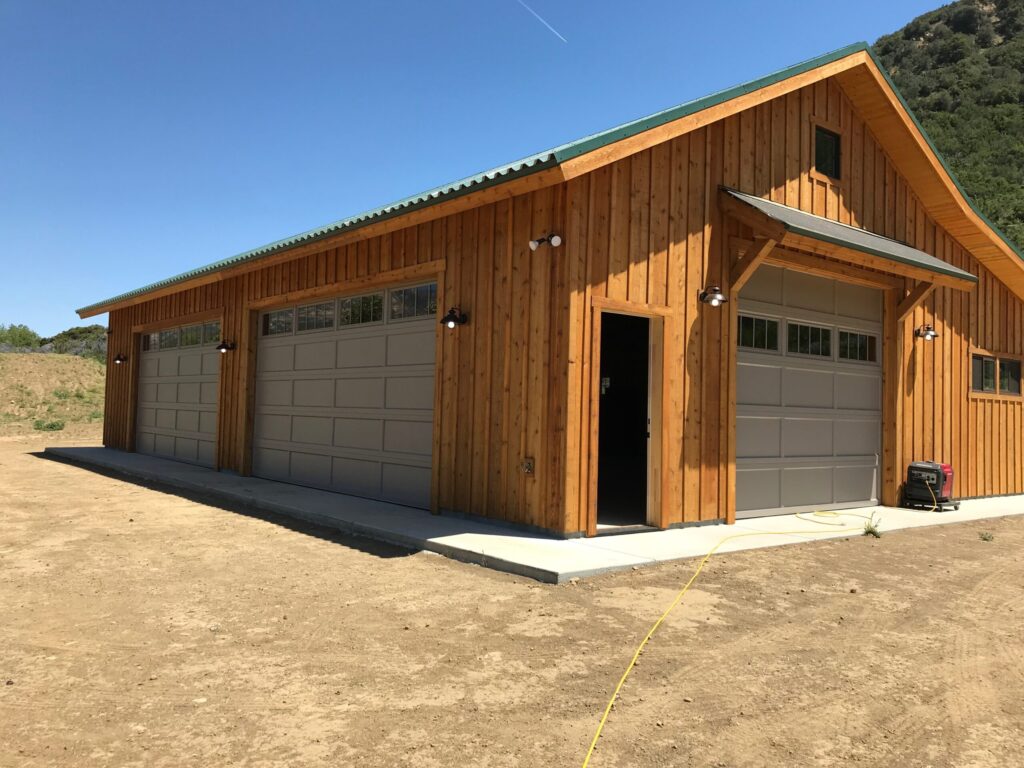
Bellingham’s commercial and light-industrial buildings cluster mostly along Route 126, around the business park off Maple Street, and in the smaller mixed-use lots near the town center. Much of this stock went up from the 1970s through the 1990s as Bellingham grew out from a farming town into a bedroom and small-industrial community for the 495 corridor, and the garage and bay doors reflect that era: wide steel sectional doors on bays built for delivery trucks and box vans, often in the 10 to 14 foot width range, paired with chain or screw-drive commercial openers.
Newer units near the town’s more recent commercial development tend to run heavier insulated steel doors with higher cycle-rated springs built in from the start. Older buildings, including some converted barns and outbuildings that now serve as small workshops or storage for local trades businesses, sometimes still run older wood or early steel doors that were never upgraded for their current commercial use. Those are usually the ones we find running residential-grade springs on a door that’s being used well beyond what that hardware was built for.
Whatever the building and whatever the door, the questions are the same: is it balanced, is the spring rated for the cycles it’s actually seeing, and does the opener stop and reverse the way it’s supposed to. Get those three right and most commercial door problems stay small.
What it costs
Commercial door repair runs from {PRICE_LOW} to {PRICE_HIGH} depending on the door. A single cable or drum repair sits at the lower end. A full torsion spring replacement on a high-cycle commercial door, or a repair that also requires resetting opener force and limit settings after a motor or circuit board issue, sits higher. Door width, spring type, and whether the opener needs attention on top of the door hardware all move the number. We give you the figure after we’ve looked at the door, not before, because quoting a commercial repair sight unseen is how people end up paying for parts they didn’t need.
How fast we can get there
We run out of Bellingham, so most commercial calls in town are a short trip for us. We don’t promise a fixed arrival window here because commercial jobs vary in urgency and in what’s already on the schedule, but call and we’ll tell you honestly where you fall in the day.
Got Questions?
Emergency Repair FAQs
Do you work on roll-up and sectional steel commercial doors in Bellingham?
Yes. Most of what we see in Bellingham's commercial buildings is steel sectional doors on loading bays, along with some roll-up units. We work on both, along with the chain-drive and screw-drive openers that typically run them.
My bay door opener runs but the door barely moves. What's wrong?
That's usually a spring problem, not an opener problem. If the springs have lost tension, the opener is trying to lift weight it was never built to carry on its own, which looks like a weak or struggling motor but isn't.
Can a commercial door's safety reversal fail without anyone noticing?
Yes, and it's one of the more common issues we find on older commercial openers. The force and limit settings drift over time, especially on high-cycle doors, and a door can stop reversing properly on contact without any obvious warning sign until it matters.
Is a high-cycle spring really necessary for a commercial door?
If the door is cycling more than a handful of times a day, yes. Standard-duty springs built for residential use wear out fast under commercial cycle counts, and the repeat failures cost more over time than installing the correct spring once.
Do you handle both repair and full door replacement for commercial buildings?
Yes, both. Some calls are a single worn part on an otherwise sound door. Others, especially on older converted buildings, call for replacing the whole door and opener with hardware actually rated for how the space is used now.
Request a Free Quote
For planned replacements, upgrades, or a second opinion on a quote you’ve already received, we’ll come look at the door, the opener, and the building’s actual usage pattern before putting a number on paper. Reach us at {PHONE} to set up a time.
Schedule Commercial Garage Door Service
If a bay door won’t close, won’t open past a certain point, or the opener is cycling without actually moving the door, call {PHONE}. Tell us what the door is doing and we’ll tell you what we think it is before anyone drives out.